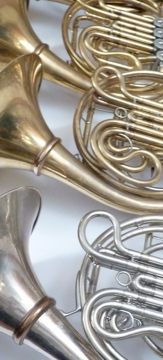
Few instruments seem as romantic and mysterious as a French horn. There are so many great sounds and great musical moments for horn but it is fraught with difficulty and danger.
We have the smallest mouthpiece, tubing almost as long as a tuba and a bell almost as large. We can blend with the flutes or blast over an entire orchestra. Good players have a five octave range, most of it usable.
Horn playing is like ice dancing on stilts while doing puzzles and lifting weights, while all the time someone is waving a stick at you trying to get you to dance in time with the music and the other players.
Check out Whip Your Brass Into Shape for notes on creating a good ensemble.
General rules that will help your horn players play their best

We believe every player must know how to conduct in order to play intelligently in an ensemble. Make sure they know the basic beat patterns and how prep beats work.
Teach them to hear perfect intervals and you will have a much better in tune ensembles. Perfect intervals have special qualities on a horn and the players will learn what they sound like if they are pointed out a few times. Read our article on intonation for help on tuning them.
Bands and orchestra go to great trouble to have all the principal woodwind and string players sit together but brass sections are frequently arranged in a straight line. Why? Your last French horn is now halfway across town from the tuba! Especially in younger groups it will help them greatly to sit as a section. Not only will they play more cleanly they will have more luck entering after a rest together.
About clams
No one wants the right notes to come out more than the player. No one. And as difficult as it is we are frequently put in a position that encourages clammy playing.
The factors you can't change come from the design and writing for horn. We miss more notes than any other instrument mostly because our open notes are so close together. For example on a Bb trumpet there is only one open note between third space C and the G at the top of the staff. On an F horn there are four. For some notes we can use as many as six different fingerings.
Other factors that make horn players clam are muscle fatigue (embouchure or ab muscles), intonation problems, sudden changes in the room air pressure or temperature and the intonation of the ensemble.
If a horn player walks into a room where people are warming up and are generally playing in tune it will be easy to play. You want to play an A 440? Someone in the room is probably already playing it or something in tune with it. But if you walk into a room where the intonation is all over the place you will be trying to play an A 440 when an A 443 and an A 438 are going into your bell, fighting your attempt to play. Instead of the sounds going into your bell reinforcing the note you want to play, there will be sounds interfering with it.
Asking players to play too quietly or too loud will also cause clams. You have to be judicious. We have to fill the tube with enough air to keep a steady sound and not so much that we break it.
And try to have a friendly attitude towards your players. If they are truly trying you will not make it better by taking it personally.
We have the smallest mouthpiece, tubing almost as long as a tuba and a bell almost as large. We can blend with the flutes or blast over an entire orchestra. Good players have a five octave range, most of it usable.
Horn playing is like ice dancing on stilts while doing puzzles and lifting weights, while all the time someone is waving a stick at you trying to get you to dance in time with the music and the other players.
Check out Whip Your Brass Into Shape for notes on creating a good ensemble.
General rules that will help your horn players play their best

- Do NOT have the horns sit in front of the tympani. Even if they don't complain. Many horn players are not even aware that this causes problems. The energy from the tympani goes right into the bell where it concentrates and focuses - right at the embouchure! If your horn section gets tired quickly and misses lots of notes try placing them or the tympani in an other location.
- Do not ask your horn players to play the same high passages over and over. Even if they play them well you will be tiring them out.
- Do not ask your horn players to play during your 'warm up' rehearsal right before a concert. How many youth symphonies get ready for playing a Tchaikovsky symphony by playing through the whole thing right before the concert! You are asking high school players to play a difficult, tiring piece of music twice! Your players will feel guilty not playing during your warm up rehearsal and will want to play every note. Don't let them! Do you want me to sound good before or during the concert?
- Demand that your horn players count
- Demand daily practice
- Don't allow slouching or sloppy breathing
- Don't teach from rote. Make them learn how to read!
We believe every player must know how to conduct in order to play intelligently in an ensemble. Make sure they know the basic beat patterns and how prep beats work.
Teach them to hear perfect intervals and you will have a much better in tune ensembles. Perfect intervals have special qualities on a horn and the players will learn what they sound like if they are pointed out a few times. Read our article on intonation for help on tuning them.
Bands and orchestra go to great trouble to have all the principal woodwind and string players sit together but brass sections are frequently arranged in a straight line. Why? Your last French horn is now halfway across town from the tuba! Especially in younger groups it will help them greatly to sit as a section. Not only will they play more cleanly they will have more luck entering after a rest together.
About clams
No one wants the right notes to come out more than the player. No one. And as difficult as it is we are frequently put in a position that encourages clammy playing.
The factors you can't change come from the design and writing for horn. We miss more notes than any other instrument mostly because our open notes are so close together. For example on a Bb trumpet there is only one open note between third space C and the G at the top of the staff. On an F horn there are four. For some notes we can use as many as six different fingerings.
Other factors that make horn players clam are muscle fatigue (embouchure or ab muscles), intonation problems, sudden changes in the room air pressure or temperature and the intonation of the ensemble.
If a horn player walks into a room where people are warming up and are generally playing in tune it will be easy to play. You want to play an A 440? Someone in the room is probably already playing it or something in tune with it. But if you walk into a room where the intonation is all over the place you will be trying to play an A 440 when an A 443 and an A 438 are going into your bell, fighting your attempt to play. Instead of the sounds going into your bell reinforcing the note you want to play, there will be sounds interfering with it.
Asking players to play too quietly or too loud will also cause clams. You have to be judicious. We have to fill the tube with enough air to keep a steady sound and not so much that we break it.
And try to have a friendly attitude towards your players. If they are truly trying you will not make it better by taking it personally.