Showing posts with label Left Coast Horn Playing. Show all posts

Sunday

Blasting the Air

Left Coast Horn Playing uses several exaggeration techniques to accelerate learning. Being able to suddenly produce an intense, focused blast of air is a basic technique of playing and is best learned by exaggeration.

It is imperative that we learn to control the flow and changes in flow of air from as low in our abdomen as possible. The lower the control the better and more efficient the sound, the more relaxed the mouth and throat can be and the more control we have over the music!

It is also imperative that one learns to breath using muscles low in the body. How can you blast air from lungs that are not full or by using muscles in the rib cage? Foolishness!

It is also very difficult to tongue cleanly if the air is controlled from too high up in the body. That makes the throat and tongue tense! How can you control it if it is already tense?


Many people do not have a lot of strength in Place #6. That is why we have to work at our breathing exercises every day. Forget your embouchure weights and other gizmos!  Spend that time working on blasting the air and trilling properly and you'll improve much faster!

To blast the air properly
  • Get your body in a proper position to take a huge breath.
  • If the muscles around Place #6 are not relaxed you cannot do this properly.
  • Take a quick, full breath, using an oh sound, filling the bottom of your lungs first. Do not raise your shoulders.
  • Suddenly tighten the muscles around and just below your belly button as if someone was hitting you in the gut. Push in and a little bit up. Do it hard! Violently!

You should get a sudden blast of air. If not, try it again. Work at it once or twice every day and in a short time your playing will improve.


Thursday

Getting Comfortable On Stage

Everyone has stage fright. It’s normal. It’s a part of being a performer and for most of us it will be until we hang it up and leave the stage. It can be painful to watch and live through.  And feel like death would be preferable. But there is hope for all!

Performers want some anxiety. A performance with no jitters and the energy it produces would be boring for everyone. But it’s easy to get into a state where the anxiety feeds on itself. What if? The reinforcement that something could go wrong makes even more nervous.

You can control your thoughts by focusing them. If you wonder what will happen, it’s easy for the negative thoughts to take over. But if your brain is busy doing other things it won’t have time to turn negative. You could worry about other aspects of your life. If you are worried about World War Three your ten second solo doesn’t seem so important. As famed track coach Bud Winter said, “If you make everything a matter of life and death you are going to die a lot.”

The world is full of suggestions, techniques, gadgets, programs and blaming it on your childhood to relieve stage fright. They usually involve teaching you some thought, idea or motion that you repeat many times. They involve changing your vision, pressing an acupressure point or yelling ‘serenity now’ over and over. They do work if you practice them. You get your body to learn to respond the way you want it to.

It helps to realize that fear is a gift. It protects us. By embracing it we can keep its effects from taking over.

Perhaps the best tidbit on the web on stage fright is here.

Musicians do have some weapons other people don’t. If you perform several times a week then the perception of danger relaxes. If you perform once a decade its importance and perceived danger will be out of proportion.

Competence and confidence are all important. If you don’t have one you can’t have the other. So as we practice and get more competent we are more assured that the things we fear won’t rear their ugly heads.

There are also chemical weapons we use. Some people take beta blockers (they reduce the amount of adrenaline produced by your body), alcohol and other drugs. These are very dangerous and usually counter-productive steps. Experience and enthusiasm are the best drugs!

NOTE: If you are going to take beta blockers discuss them honestly with your doctor before doing so. They are dangerous substances and react with other medicines or cause other problems. No concert is worth dying for. Not even when there are Left Coast Players playing!


Saturday

Know How to Conduct

We are not kidding.

How can you play well in an ensemble if you don't know what the conductor is doing?

You should know at least how to conduct a preparation beat and the basic beat patterns. There are only 4 so it's not a big deal. You also need to know what an ictus is. (It's the point in the beat pattern where the beat actually happens.)


Wednesday

Sample Practice Plans

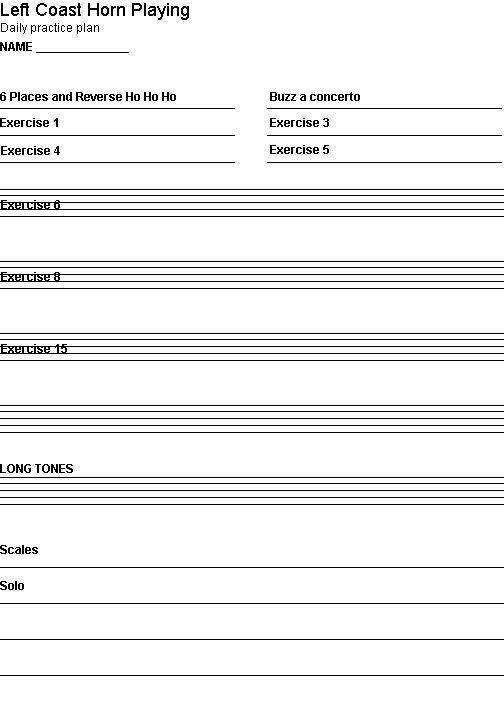
The basic outline of a Left Coast practice plan
  • Breathing exercises and routines
  • Buzzing exercises
  • A simple exercise done the same way every day
  • Arpeggio exercises
  • Tonguing exercises
  • Exercises for special problems or to develop other techniques
  • Long tones
  • Scales
  • Music
    Each of our exercises can be extended or leveraged. For example Exercise 1b might be played as plain as possible or with decrescendos on the last note, or continued on as low as possible, etc.

    For a young student or beginner the entire routine before the music might only take ten minutes, for an advanced player it can be an hour or more.

    Note that on the sheet we have an area where there are staves. You can write notes or variations on the exercises or write new exercises.


     Click for Printable Version
    Sample Beginner Practice Plan


     Click for Printable Version
    Sample Intermediate Practice Plan


     Click for Printable Version
    Sample Professional Practice Plan


    Stopping the Notes with the Tongue and Reverse Tonguing

    For the purposes of these exercises we do not allow stopping any notes with the tongue.

    Many very good players stop notes with the tongue but they have had to spend many hours fighting the problems it causes. Some of them will claim that they can play shorter and cleaner than those of us who do not stop the notes with the tongue but that's bogus.

    One of the most beautiful sounds is a horn playing a beautiful decresendo down to nothing. You can't do this unless you learn to control the air a the end of the notes, and if for this reason only you must learn to play without this evil problem.

    Do not stop any of the notes in these exercises with the tongue.

    Stopping the notes with the tongue almost always means the player cannot stop the air without the tongue and this causes many problems. Many players thrust their tongue forward creating tension in the tongue and throat and restricting the flow of air.

    Players who habitually stop the notes with the tongue frequently have problems starting notes with a clean T. They wind up starting with what we perjoratively call H tonguing. There is no T and all the notes are snuck into.

    Tonguing the end of a note but not the beginning is reverse tonguing and it is evil.

    If you are unable to stop a note without the tongue you have some work to do. You have to accept that for a while you will have trouble ending notes cleanly. That's ok, let it sound bad at first.

    You have to be your own police and every time you catch yourself ending the notes with the tongue you have to be angry! Make it stop! Learn to control the ends of the notes by forcing yourself to use the air rather than your tongue.


    About Left Coast Horn Playing Technique

    Left Coast Horn Playing is a way of practicing and playing that emphasizes training the body and mind to inhale and exhale correctly.  Left Coast Horn Playing takes a logical and behavioral approach and develops controlled, repeatable technique. Our techniques are not designed to produce a single unchangeable style, rather they are designed to give you control over your style by developing a wide palette of repeatable techniques.

    Main features of Left Coast playing and practice

    • We have a daily plan and we follow the plan
    • We focus on controlling the air inside the horn and working daily to improve breathing with the goal of controlling the flow of air from as far down in the abdomen and as far forward in the mouth as possible
    • Knowing what and where the target is and aiming the air at it
    • Getting away from the illusion that concentration and development of the embouchure is more important than focus on air control and emphasizing exercises that develop air strength and control
    • Use of exaggeration in teaching. Sffz, long decrescendos and practicing in a wide range of tempi are typical
    • Clean tonguing and using the tongue to focus the air
    • Working to reduce or eliminate unnecessary movement of the face and tongue by focusing on air control
    • Short progressive and leveraged drills designed to hone in on one particular aspect of playing or combining techniques to make learning efficient
    • Working to improve ensemble skills as well as individual technique

    Monday

    Notes for Conductors and Teachers

    Few instruments seem as romantic and mysterious as a French horn. There are so many great sounds and great musical moments for horn but it is fraught with difficulty and danger.

    We have the smallest mouthpiece, tubing almost as long as a tuba and a bell almost as large. We can blend with the flutes or blast over an entire orchestra. Good players have a five octave range, most of it usable.

    Horn playing is like ice dancing on stilts while doing puzzles and lifting weights, while all the time someone is waving a stick at you trying to get you to dance in time with the music and the other players.

    Check out Whip Your Brass Into Shape for notes on creating a good ensemble.

    General rules that will help your horn players play their best
    • Do NOT have the horns sit in front of the tympani. Even if they don't complain. Many horn players are not even aware that this causes problems. The energy from the tympani goes right into the bell where it concentrates and focuses - right at the embouchure! If your horn section gets tired quickly and misses lots of notes try placing them or the tympani in an other location.
    • Do not ask your horn players to play the same high passages over and over. Even if they play them well you will be tiring them out.
    • Do not ask your horn players to play during your 'warm up' rehearsal right before a concert. How many youth symphonies get ready for playing a Tchaikovsky symphony by playing through the whole thing right before the concert! You are asking high school players to play a difficult, tiring piece of music twice! Your players will feel guilty not playing during your warm up rehearsal and will want to play every note. Don't let them! Do you want me to sound good before or during the concert?
    • Demand that your horn players count
    • Demand daily practice
    • Don't allow slouching or sloppy breathing
    • Don't teach from rote. Make them learn how to read! 

    We believe every player must know how to conduct in order to play intelligently in an ensemble. Make sure they know the basic beat patterns and how prep beats work.

    Teach them to hear perfect intervals and you will have a much better in tune ensembles. Perfect intervals have special qualities on a horn and the players will learn what they sound like if they are pointed out a few times. Read our article on intonation for help on tuning them.

    Bands and orchestra go to great trouble to have all the principal woodwind and string players sit together but brass sections are frequently arranged in a straight line. Why? Your last French horn is now halfway across town from the tuba! Especially in younger groups it will help them greatly to sit as a section. Not only will they play more cleanly they will have more luck entering after a rest together.

    About clams

    No one wants the right notes to come out more than the player. No one. And as difficult as it is we are frequently put in a position that encourages clammy playing.

    The factors you can't change come from the design and writing for horn. We miss more notes than any other instrument mostly because our open notes are so close together. For example on a Bb trumpet there is only one open note between third space C and the G at the top of the staff. On an F horn there are four. For some notes we can use as many as six different fingerings.

    Other factors that make horn players clam are muscle fatigue (embouchure or ab muscles), intonation problems, sudden changes in the room air pressure or temperature and the intonation of the ensemble.

    If a horn player walks into a room where people are warming up and are generally playing in tune it will be easy to play. You want to play an A 440? Someone in the room is probably already playing it or something in tune with it. But if you walk into a room where the intonation is all over the place you will be trying to play an A 440 when an A 443 and an A 438 are going into your bell, fighting your attempt to play.  Instead of the sounds going into your bell reinforcing the note you want to play, there will be sounds interfering with it.

    Asking players to play too quietly or too loud will also cause clams. You have to be judicious. We have to fill the tube with enough air to keep a steady sound and not so much that we break it.

    And try to have a friendly attitude towards your players. If they are truly trying you will not make it better by taking it personally.

    Templating

    We spend so much time and effort trying to learn what the inside of our mouth should be and how to shape the air it is a pity to waste it. But that's what many of us do.


    How likely are we to hit the half note cleanly? Much of it depends on what we do during the eighth notes and the quarter rest.

    If we play the eighth notes nicely then we want to use them as examples, as templates for what is coming up.

    Many players would move their mouths and let their throats collapse as their System changes and relaxed during the rest.  Not Left Coast Players! We would try to keep our entire system as much the same as possible  so that we keep our set up to use on the next note.

    Consider this snippet. Now we have not only a different note after the rest but it is an octave higher! What to do..

    Most players would spend the quarter rest raising their shoulders (and eyeballs), tensing the throat and perhaps taking a shallow, hamster like breath - all things that make the top note harder!

    Left Coast Players know what to do. We try to keep our System as much the same as possible. We will try to aim for both Gs in the same place with as little change in our embouchure or the inside of our mouth as possible.

    We will stay still during the rest and use the G eighth note as a template for the upper note. Even if we take a breath we will try to keep our mouth as still as possible.

    Instead of re-creating our system for the new note we keep the one we had just been using.


    If you ask most horn players what the most important note of this phrase is you will get different answers but to us there is only one - it's the first note.

    It's the note we are most likely to clam. It's also the most useful note!

    If you are careful and play a well supported, cleanly tongued note then you have a template, an example of how to have your system shaped for the rest of the phrase. Since we are trying to make all the notes feel as much the same as possible we want to be extra careful to make the first note nice and use it for all the following notes.

    Templating is also very useful for developing low and high ranges. Start your drills in your mid range and move up or down slowly, trying to keep the mouth shape of the mid range as much as possible.

    What is The Target?

    The Target is where we aim the air.

    It is the center of the upper lip, at its lowest point. If you stick your tongue out and close your lips, it is where you tongue touches the upper lip.

    The Target is where your lip actually vibrates.* It's where we want to aim the air. Always. We can aim up or down but the air must pass through the target.

    Most players aim up higher than the target, especially when playing high notes. Unfortunately aiming above the target makes it harder to play high notes!

    It make so much sense, to aim up when we play high and to aim low when we play low.  Fortunately for those of us in the know aiming up or down doesn't make the pitch go up or down.

    What makes the pitch go up or down depends on the size of the aperture (the hole where the air goes out your lips), the speed and intensity of the air and the tension of the lips.

    Note that we are talking about aiming the air at the Target or above or below it.  All air should be aimed at the Target regardless of pitch or range.

    This straight ahead kind of playing has numerous advantages
    • It helps to keep the tone quality good and similar in all ranges
    • It make slurring smoother
    • It allows for large leaps without changes in tone
    • It helps you understand where to tongue

    Why Tongue at the Target?

    Tonguing at or near the target produces clean and powerful attacks and reduces the movement of the tongue. Moving the tongue too much brings the back of the tongue into play, constricting the flow of air, changing the tone and slowing the tonguing down.

    When most people tongue at the Target for the first time they can't believe it can work because they are so used to tonguing higher.

    Having a Target gives you something to aim at

    How handy!

    You know that feeling right before a high, quiet entrance? How are you going to get the first note to sound nice? Wouldn't it be great to get rid of that abstract, almost lost feeling?

    You have a really loud entrance and don't want to splat the first note?

    Give your brain and body something to focus on! Think about the target, where it is and how you are going to deliver the air to it.


    * Yes we know vibrates is the wrong word but let's keep it simple.

    Don't Drop Your @#$&!@# Jaw!

    Few words have done more damage to horn players' low ranges than the dreaded 'Drop the Jaw.'

    To develop a controllable focused low range try not to move your jaw when you play lower. Practice playing in the mid range and using that mouth shape as a template for your low range.

    Dropping the jaw before the note starts does several things, all of them bad.
    • It makes it difficult to focus the air
    • It causes the back of the tongue to move up, restricting the flow of air
    • It makes it almost impossible to return to the middle or upper ranges without terrific amounts of tension
    Note that we do not say the jaw does not move or the mouth get slightly bigger when playing low. The difference is that we let our mouth relax and find the right shape from the acoustics of the note. We do not try to put the mouth in the right shape first.

    We want the shape of our mouth for our lowest and highest notes to be the same as much as possible.

    Saturday

    Your Hands

    Let's start with the most neglected of our hands - the left hand.

    Many people think the left hand - well, most people ignore their left hand. But learning to use your left hand properly will make you play cleaner and enable you to play faster.

    Two very important issues for the left hand are the position of your little finger and whether you use the tips or the pads of your fingers to depress the keys.

    If you little finger is too close to the ring finger, the ring finger won't be able to move independently. If your ring finger moves slowly or is difficult to coordinate then it is probably too close. See a qualified repair person and have them adjust the little finger position for you.

    The fingers of the left hand should be curved as if holding a ping pong ball. If the fingers are not curved, the pad of the finger rather than the tip pushes on the lever. This uses the muscles of the top of the arm (where the hair grows). This muscle is slower and weaker than the muscles on the bottom of the arm. To feel which muscles to use make a fist and press your fingertips into the palm of your hand.

    Using straight fingers and pressing with the pads causes the valves to be partially open for a longer time than if the fingers are curved and the very tip of the fingers pushes the valves. This partially open condition makes the horn more likely to produce the wrong note, or a note that ‘cracks’ at the beginning. It makes general coordination much more difficult and decreases the speed and fluidity of playing.

    For very legato playing when you want mushy, romantic slurs go ahead and straighten your fingers out.

    Now the second most neglected hand - the right hand.

    The right hand directs the flow of sound between your hand and your body. It should be against the right side of the bell, away from the body. Do not position your hand at the top of bottom of the bell.

    There are many useful and proper shapes for the right hand. Different parts of the world use different shapes and you can learn to use the shape of your hand to produce different timbres. For example if you are trying to blend with woodwind sounds you might spread your fingers a bit and move your hand across the bell a bit to muffle the sound. To play bright and blatsy you might straighten your fingers and keep your hand to the right.

    One indication if your hand is in the right position is if you can lower your pitch a half step by moving your wrist across the bell (keep your elbow and finger tips in the same place). Note: this is difficult for very young players and sometimes it's best to just keep their hands out of the way and pull the tuning slide out.

    A common mistake that gets the right hand out of position is to keep the right elbow too close to the body. This tends to bring the right hand too close to the body too, muffling the sound.

    Advanced players know that by using the right hand to adjust intonation we keep away from adjusting with our lips. Adjusting intonation with your lips makes your mouth move all the time (bad), reduces your endurance (bad!) and wrecks your tone and control (bad and bad!)

    The C Word

    It's a word you hardly hear in connection with brass playing and that's a shame, since it is one of our most important concepts. It allows us to play cleanly and makes our technique much easier.

    The word is Coordination!

    We have to coordinate the timing of the lips, fingers, abdominal muscles, and tongue on every note. The timing is critical! Small changes in timing can have deleterious or beneficial effects.

    This is one more reason it is so important to practice slowly and carefully several times a day and why the Slow to Fast practice technique is so valuable.

    A common coordination problem is the relationship of air control and embouchure when slurring. Most people increase the air flow for a slur too late, after the chops start changing. This is a common fault of face-based playing. When slurring the air should move first.

    Experiment with your timing and you will find your playing much improved. The act of working on it will make you a better player.

    Sample Practice Plans

    The basic outline of a Left Coast practice plan looks like this
    • Breathing exercises and routines
    • Buzzing exercises
    • A simple exercise done the same way every day
    • Arpeggio exercises
    • Tonguing exercises
    • Exercises for special problems or to develop other techniques
    • Long tones
    • Scales
    • Reading and learning music

    Each of our exercises can be extended or leveraged. For example Exercise 1b might be played as plain as possible or with decrescendos on the last note, or continued on as low as possible, etc.

    For a young student or beginner the entire routine before the music might only take ten minutes, for an advanced player it can be an hour or more.

    Sample Beginner Practice Plan
    Ten minutes
    • Reverse Ho Ho Ho and 6 Places
    • Mouthpiece buzzing exercise
    • Exercise #1b (done allegro with brick shaped notes)
    • Exercise #8
    • Long tones
    • Scales
    • Etudes, solos and music preparation

    Sample Intermediate Practice Plan
    Half hour
    • Reverse Ho Ho Ho and 6 Places
    • Mouthpiece buzzing exercise
    • Exercise #1b (done allegro with brick shaped notes)
    • Exercise #2
    • Exercise #3
    • Exercise #4
    • Exercise #6
    • Exercise #8
    • Long tones
    • Scales
    • Etudes, solos and music preparation
    • Exercise #1a
    Notice that Exercise #1a is always done last and every other day.

    Sample Practice Plan for a Professional Player or Advanced Student
    45 minutes to an hour
    • Reverse Ho Ho Ho and 6 Places
    • Mouthpiece buzzing exercise
    • Exercise #1b (done andante and going down as low as possible)
    • Exercise #2 (with extended variations)
    • Exercise #4
    • Exercise #5 (all versions)
    • Exercise #6 (two octaves)
    • Exercise #7
    • Exercise #8 (for double tonguing, high and low range practice)
    • Long tones
    • Scales
    • Etudes, solos and music preparation
    • Exercise #1a

    Strength and Efficiency

    Strength is good. Efficiency is good Strength plus efficiency = the best!

    Knowing which muscles need to be strong and which need to learn to relax is key. We need to have the muscles at the corners of our lips to be very, very strong. We need our lower abs to very strong. That's about it.

    We need to keep the muscles of the throat relaxed, especially the lower part of the tongue. Your tongue is probably longer than you think. When you swallow the lower part of your tongue helps to push the material down your throat. You can feel the tongue flexing all the way down to your vocal chords.  

    Tension in the back and bottom part of the tongue is one of the most common problems in brass playing.

    How do we overcome this tension? By breathing from Place #6. Controlling the air in our out from above Place #6 causes causes tension in the throat.

    To gain the strength in Place #6 we constantly remind ourselves to breathe from there. We strengthen those muscles simply by breathing correctly over and over.

    We strengthen our chops by playing progressively longer and higher drills. Long tones are very important. Long descrescendos help too.

    We define efficiency as the percentage of air that goes through the mouthpiece without increasing the buzzy quality of the buzz. You can hear two things in a buzz, the raspy buzzy sound and the hissing of the air. The hissing airy sound is the inefficient air.

    The airier and hissier the sound of the buzz the less efficient. The raspier and buzzier the sound the more efficient.

    Some benefits of being more efficient are obvious but there are many that are not so obvious. Intonation is greatly improved with an efficient buzz, as are endurance, flexibility, steadiness, tonguing, quiet playing and phrasing.


    Contact Scott Hartman

    For Mr. Hartman's biography check the Santa Clara University site
    http://www.scu.edu/cas/music/facultyandstaff/scott_hartman.cfm

    Mr. Hartman performs extensively throughout the Bay Area and Central Coast. He coaches school, youth and community symphony and professional brass sections throughout California.

    Mr. Hartman teaches privately at his home in west San Jose.

    For schedules, fees and travel rates please contact him via email or telephone.

    Scott Hartman
    Scottito@Pacbell.net
    (408) 781-0019

    Wednesday

    Don't Play the Horn!

    You can't! No one can!

    The horn is a tube. That's all. Just a tube. When we play it just sits there. The only thing it really can do is get shorter or longer.
    They are just fancy tubes!

    What we really play is ourselves and the air trapped inside the tube.

    This is an important distinction. Understanding what is going on with the air inside the horn allows you to focus on controlling the air rather than the embouchure.

    How to Make the Right Sound - About Tone Color

    How do I make the right sound?

    How do I sound like the big symphony players I hear? 


    Do I need special equipment? A huge body? Big lung capacity?
    These are some of the most vexing problems in learning to play.

    How do we know what sound to make when it is different to me than it is to the audience?

    If you sit next to a horn player on stage and listen to them then move to the audience you will be amazed at how different it sounds. If you move around the hall it will sound different in every spot.

    Then what sound is ‘right?’


    What Influences Your Sound
    • Your body, throat and mouth
    • The mouthpiece
    • The leadpipe
    • The cylindrical section
    • The bell branch
    • Your right hand
    • Your clothes
    • The room
    • The listener’s ear and the listener’s brain

    It’s affected by what other sounds are being made and the textures of the surfaces of the room.

    So what does matter
    • The sound is clear and in tune.
    • Volume and pitch are generally brick shaped yet conform to the phrase
    • The air is being controlled from around and below the belly button
    That’s about it.

    Airy and fuzzy sounds don’t travel far so they shouldn’t worry you too much, as long as you are breathing correctly and the notes are shaped correctly.

    Tone Color

    A much more important concept for us to pay attention to is tone color.  Think of it as how bright and shiny or warm and dull your sound is.

    It’s great to be able to change tone color while making music, but for these exercises try to keep a clear, bright tone color at all times.

    In Exercise #1 the goal is to try to get all the notes to have the same tone color as the first note. If you play the three note pattern and the third note has a different tone color then something is changing that doesn’t need to change or that note is out of tune and that makes the color change. In any case it indicates that something is moving that doesn’t need to.

    A great way to get a feel for breathing from Place #6 is to practice decrescendos without letting the tone color change. If the sound gets dark and dull as you get quiet then you are not doing it right. If you keep the tone bright and straight while decrescendoing.

    What will make tone color change when doing the exercises
    • Shallow breathing, controlled from too high up
    • The air support sagging, especially at the end of notes
    • Excessive movement of the jaw
    • Movement in the tongue near the molars
    • Tension in the tongue or cheeks
    It can be difficult to tell when we are playing. It helps to have another player listen to figure what might be causing a problem.

    Being able to control your tone color is a huge part of Left Coast Horn Playing. We work on it every day.

    In General

    We are in no way saying that this is how you should always sound but for these drills it helps to keep a bright shiny sound because that’s when the air is used most efficiently.

    These exercises are to gain strength, efficiency and control, not to define a playing style. That is separate.

    It’s easy to hear a bad tone color. Almost always the root of the problem is controlling the breath too high, making it weak and wobbly.

    Anatomy of a Slur

    Left Coast playing techniques teach us to have the control to use many different articulations and to have different qualities of slurs. Sometimes we want the smoothest sound possible, sometimes we want the fastest slurs possible and sometimes we want to smoooosh it up so it’s lush and romantic. We want to be able to control the type of slur we work on the extremes.

    However the vast majority of the time we want the quickest, smoothest slurs possible even when playing legato. It simply sounds better.

    What is the anatomy of a slur?

    Think of a slur as having three parts: the first note, the second note and the time that we are changing from the first to the second.

    Many players begin their slurs as soon as they have hit the first note. If the second note is higher then first note tightens and the mouth begins to tense. Sometimes the eyes, shoulders and head raise up! Aack! If the second note is lower the mouth opens and the jaw drops. Oh no!

    The first note should be as straight as possible (unless there are phrasing issues).

    The air should change first, before the lips or tongue to begin the move to the second note.

    The mouth and throat should be relaxed so that the new note can sound and the air can flow.

    In general the effort you put into changing notes should happen as quickly as possible. We want to play the first note without hinting whether the next note is higher or lower. We want the energy and movements we make to change notes take up the least amount of time as possible.

    Even for legato playing we want the valves to move quickly and the air and embouchure changes should be rapid. The only exceptions are to make a really mushy legato slur.

    See Understanding Note Clusters for more hints on making smooth slurs and explains what happens inside the horn as you change from one note to another.

    Of all the things that happen when we change notes the air should be the first to move. If the lips or mouth move first we hear that in the note as a decrease in volume, a dulling of the tone color and change in intonation. It also keeps you from aiming at the second note with the air and encourages ‘push and pray’ playing instead of aggressive air playing.

    A common problem and one that causes all sorts of horn misery is the air slowing down on the end of the first note of the slur. It is usually caused by the back of the tongue raising up to ‘get ready’ for the new note but this takes our mouth out of position and creates wind resistance! We want to increase the air during the slur. You can learn to do this by playing a crescendo during the first note of the slur and continuing to crescendo during the slur and into the second note.

    You want to increase the flow of air during the time the notes are changing. You want to use the increase in air to aim at the new note, especially when the new note is lower. We have this tendency to think of the lower note as easier and taking less air, giving a 'falling' quality to the slur. Evil! Lower notes take more air, not less and decreasing the air and falling makes us hope to get to the right note rather than aiming at it.

    Even slight reductions in the air volume at the end of the first note can cause problems. It’s helpful to have a friend listen carefully while you practice this to see if you can eliminate it.

    Ah vs Oh and the Reverse Ho Ho Ho

    When you inhale you want to get the air down in the bottom of your lungs first. To do this we need to use an oh syllable when we inhale, not an ah syllable.

    The more attention you pay to this the better player or teacher you will be. This is the most important concept in Left Coast Horn Playing.

    For a teacher it is easy to hear when the student is breathing from Place #6. The 'oh' sound is unmistakable when inhaling and the deep, round tone color is unmistakable when playing.

    Make sure the oh sound happens from the beginning of the breath to make sure the bottom of the lungs fill up first.

    Left Coast Horn Playing has produced many fine adolescent players. It's simplicity and focus on what works gets their minds and bodies working on the right things.  In our quest to make things simple we came up with this idea to get the air low in the body. 

    Santa Claus says "ho ho ho" and so do we. But we say while inhaling! Say it strongly and use the Place #6 muscles. You'll note that if you breathe from higher up you will say 'ha ha ha' instead of 'ho ho ho.'

    Don’t move!

    Many of the problems we have are caused by parts of our bodies moving when they should be still, or being tense when they should be more relaxed.

    A big culprit is the back of the tongue and the muscles around the throat. In most cases this is caused by controlling the air at Place #5 or higher.

    There is a fancy name for this problem and it’s at the heart of most breathing treatises. It’s called the Valsalva's maneuver and you can find a lot of information about it on the web but here it is in it’s simplest form:

    If you control the air above Place #6 you will have to use the muscles in your throat and mouth to push the air out. The muscles will tense.

    If you control the air above Place #6 you will have all sorts of problems
    • Your throat will close and you will have trouble tonguing cleanly
    • Your mouth muscles and your tongue will tense up and you can’t use them to get the air focused and they won’t be relaxed enough to let your mouth find the right shape
    • Your volume of air will be small
    • Your sound will be thin
    • You will have trouble with your high and low ranges
    • You will have little volume control
    • Flexibility will be a problem
    • Intonation will be difficult to control
    Since many of us do not have the lower ab muscles developed we have to practice controlling the air down them. Do it for a couple of minutes every day and your playing will improve dramatically!