Saturday

Playing in Orchestral Style

If you have played in a band for years your first orchestral rehearsal may be a baffling experience. Playing in an orchestra requires a different set of skills and sensibilities than playing in a band.

In a band you spend most of your time playing doubled parts. Since many bands don't have enough horns or strong players, much of the music is doubled somewhere in the ensemble. In orchestral parts there is much less doubling.

In a band it's unusual to not have percussion giving you a beat. In an orchestra the percussion tends to add color and is rarely giving the beat. Orchestras operate much more like chamber music. For a more complete description of how to play in an ensemble read Whip Your Brass Into Shape - The Brigade System. It's more important in an orchestra to understand where your particular part fits in.

Another important difference is in actual playing style. Band music needs to be more staccato, just because of the nature of the ensemble and the music. Orchestral style generally needs to have longer notes.

A subset of this difference is what we call Classical style. By Classical with a capital C we mean from the Classical era, esp. the music of Mozart, Haydn and early Beethoven.

In classical style we play notes full length with a clean tongue. By full length we mean full! For example in this snippet from the Beethoven Sonata:

we would play the first note all the way until we had to tongue the sixteenth note. And we would tongue cleanly, using a T sound, not a D sound. We would play the quarters a full beat and the half notes a full two beats.

If we were playing this in a band piece we would simply separate a little bit to sound cleaner.

Focusing the Air

Have you ever blown across the top of a bottle and gotten it to whistle?

If you have then you understand the importance of focusing the air. If you just blow at the bottle without focusing you don't get a sound (other than 'whoosh') but if you focus it in just the right place you get a whistle.

We also need to focus the air in the right place. If the airstream hits your lips wider then the inner diameter of the mouthpiece rim then you are at a disadvantage. It's very hard to control the lips with the air and we will fall back into the hands of our old enemies: tension, stiffness, lack of range and endurance, intonation problems, etc.

Just like whistling we use our tongue to focus the air at just the right place.

If you can get the air to focus the same size of your aperture and right  at your aperture then you will be playing very efficiently, will make a great sound and your technique will get much easier. Combine this with proper breathing and you will be a formidable horn player!


Sunday

Blasting the Air

Left Coast Horn Playing uses several exaggeration techniques to accelerate learning. Being able to suddenly produce an intense, focused blast of air is a basic technique of playing and is best learned by exaggeration.

It is imperative that we learn to control the flow and changes in flow of air from as low in our abdomen as possible. The lower the control the better and more efficient the sound, the more relaxed the mouth and throat can be and the more control we have over the music!

It is also imperative that one learns to breath using muscles low in the body. How can you blast air from lungs that are not full or by using muscles in the rib cage? Foolishness!

It is also very difficult to tongue cleanly if the air is controlled from too high up in the body. That makes the throat and tongue tense! How can you control it if it is already tense?


Many people do not have a lot of strength in Place #6. That is why we have to work at our breathing exercises every day. Forget your embouchure weights and other gizmos!  Spend that time working on blasting the air and trilling properly and you'll improve much faster!

To blast the air properly
  • Get your body in a proper position to take a huge breath.
  • If the muscles around Place #6 are not relaxed you cannot do this properly.
  • Take a quick, full breath, using an oh sound, filling the bottom of your lungs first. Do not raise your shoulders.
  • Suddenly tighten the muscles around and just below your belly button as if someone was hitting you in the gut. Push in and a little bit up. Do it hard! Violently!

You should get a sudden blast of air. If not, try it again. Work at it once or twice every day and in a short time your playing will improve.


Thursday

Getting Comfortable On Stage

Everyone has stage fright. It’s normal. It’s a part of being a performer and for most of us it will be until we hang it up and leave the stage. It can be painful to watch and live through.  And feel like death would be preferable. But there is hope for all!

Performers want some anxiety. A performance with no jitters and the energy it produces would be boring for everyone. But it’s easy to get into a state where the anxiety feeds on itself. What if? The reinforcement that something could go wrong makes even more nervous.

You can control your thoughts by focusing them. If you wonder what will happen, it’s easy for the negative thoughts to take over. But if your brain is busy doing other things it won’t have time to turn negative. You could worry about other aspects of your life. If you are worried about World War Three your ten second solo doesn’t seem so important. As famed track coach Bud Winter said, “If you make everything a matter of life and death you are going to die a lot.”

The world is full of suggestions, techniques, gadgets, programs and blaming it on your childhood to relieve stage fright. They usually involve teaching you some thought, idea or motion that you repeat many times. They involve changing your vision, pressing an acupressure point or yelling ‘serenity now’ over and over. They do work if you practice them. You get your body to learn to respond the way you want it to.

It helps to realize that fear is a gift. It protects us. By embracing it we can keep its effects from taking over.

Perhaps the best tidbit on the web on stage fright is here.

Musicians do have some weapons other people don’t. If you perform several times a week then the perception of danger relaxes. If you perform once a decade its importance and perceived danger will be out of proportion.

Competence and confidence are all important. If you don’t have one you can’t have the other. So as we practice and get more competent we are more assured that the things we fear won’t rear their ugly heads.

There are also chemical weapons we use. Some people take beta blockers (they reduce the amount of adrenaline produced by your body), alcohol and other drugs. These are very dangerous and usually counter-productive steps. Experience and enthusiasm are the best drugs!

NOTE: If you are going to take beta blockers discuss them honestly with your doctor before doing so. They are dangerous substances and react with other medicines or cause other problems. No concert is worth dying for. Not even when there are Left Coast Players playing!


Wednesday

How to Prepare for a Judged Performance or Audition

Nowadays young players face a number of tests. We have school auditions, frequent playing tests, honor ensemble recorded and live auditions. Playing these is quite different than playing a concert for the public, as the audiences have different reasons for listening!

You'll do better on these if you understand what these differences are and what the judges are looking for. Everything you do that makes it easy for the judges to like your playing gives you an advantage over those who don't.

To Prepare Music for a Judged Performance
  • Play exactly what is on the page. Get the articulations, dynamics, etc. as they are on the page
  • Understand and play the correct rhythms
  • Know about the history and style of the music
  • If you are playing a solo, sound like a soloist
  • If you are playing excerpts from ensemble music (like orchestral excerpts or selections from a band piece) sound like you are sitting in the ensemble
  • Don't be boring
  • Get the opening salvo right
  • Master what others will not
  • Play as if you know the music down cold

Play what's on the page

What do traffic cops give most of their tickets for? Speeding, going through red lights or stop signs, not having current registration, unsafe lane changes. What do these all have in common?

They are easy to see! It's pretty easy to see if someone didn't stop completely. It's not so easy to tell if you made an unsafe lane change - unless you crash!

Audition judges are the same. It's easy to tell if a player doesn't play the articulations as written. Or if the music is marked mm = 120 and you play it at mm = 72.

If you are required to play a specific piece or edition you must play what is on the page. If you can select your own solo and have to hand a copy to the judges, you can change articulations, dynamics etc. if you mark it clearly on the part you hand to the judges. Then you have to play the piece as you have edited it.

Play the articulations as marked on the page. It's pretty easy to tell if you slur something that's marked tongued or vice-versa.

Understand and play the correct rhythms

Consider this snippet of the Beethoven Sonata:


Virtually all high school age and amateur players will play a triplet instead of the opening dotted eighth rhythm. To insure you don't play a sloppy rhythm practice the excerpt this way:


Use a metronome set to sixteenth notes. Glow slowly enough to get it right. Be sure that you count and subdivide.

Once you have that rhythm working put accents in where you actually would be tonguing notes like this:


Then practice the snippet as written, still subdividing in your head. Make sure the last sixteenths get a lot of air and a nice sound.

Know something about the history and style of the music

If you play the Beethoven Sonata like it was a Mahler fanfare or a Debussy tone poem describing an amorous satyr waking in the forest then you will have it wrong.

The judges may be trying to imagine you playing in the ensemble. If the style is all wrong you won't score strongly.

If you are playing a solo, sound like a soloist. If you are playing ensemble music sound like you fit into the ensemble

If the judges are trying to imagine you playing your concerto in front of their ensemble and you are playing too timidly it just won't feel right to them.  If you are playing a tutti part and it sounds like you are trying to outblow the universe that won't seem right either. Try to imagine what is actually happening and play to match.

Focus on the opening salvo

Your first impression is the strongest. Use it to make a statement about your playing! Take the time and care to get the rhythms right, match the style and sound like you know what you are doing. If you play the first phrase of your audition properly the listener will be predisposed to ignore little mistakes and give you the benefit of the doubt.

If you first phrase sounds sloppy, unprepared and unmusical the judges will spend the rest of your audition listening for clues that you are generally sloppy, unprepared and unmusical.

Master the parts others will mess up

Talk about getting an advantage! You can tell where the hard, tricky treacherous places are in an audition. Slam them! Learn them cold. Be the one player who hits the high note, plays the fast part cleanly or plays the low phrase tastefully. Even if you mess up other parts you will stick out as the player who got the hard parts right and that's gold!

Play as if you know the music down cold

Funny as it sounds it is very impressive to hear a player who sounds bored! Who would you want to have an important position in your ensemble, some one who sounds as if they are constantly struggling or someone who sounds like it's so easy you can do it in your sleep?


Monday

Teaching Left Coast Horn Playing from the Podium

If you are a school band or orchestra teacher you know how frustrating and confusing it can be to deal with French horns. The parts that seem simple to you seem impossible to the players. When you need to hear them they can't play louder. They seem to tire out faster than anyone else. They play the right notes occasionally and you don't know why. What to do!

We are here to help. Horn playing is different and presents different challenges but once you understand them you'll be able to deal with them.

Common Problems and Some Solutions

Most of the problems you can fix from a podium boil down to one or two common and obvious mistakes. Poor posture, shallow breathing and poor timing are culprits in the vast majority of problems.

Poor posture makes efficient breathing difficult if not impossible, reduces mental clarity and shifts vital parts of the anatomy (abdomen, left hand, right hand, tongue, etc) into bad positions. 

Shallow breathing is the pariah of horn playing. If you see a player take a gulping or snorting breath, correct them. Six Places is a really good simple way of teaching breathing, as is the Reverse Ho Ho Ho. A horn is the second longest instrument in the ensemble, with very narrow tubing and a small mouthpiece. If you don't have a lot of air in you you can't control the beast very well!

Hitting the wrong notes: As you go higher on any brass instrument the open notes get closer and closer together. Horns have a huge range and most of what we play is in the higher range.  Our notes with the same fingerings are closer together than a trumpets and a lot closer together than on a low brass instrument.

You can stop and help them find the first notes of a phrase. Many times just finding the right partial to begin on helps a lot. If they continue to have trouble, be positive and suggest they follow a daily practice routine. Have them follow our Beginner Sample Practice Plan.

We also really like Erik Bolvin's Really Big Songbook for beginners and intermediate players. It is all common melodies. Many instrumental books have folk songs from around the world, some classical tunes and new compositions. The Really Big Songbook has tunes that are known to most kids so they can tell if they are playing the right notes.

The horn books in many band programs tend to move too high in the range too quickly. It can take years for a young student to be comfortable playing a note at the top of the staff. Our advice is let them take notes down and octave whenever needed.

Getting tired is a common problem. Our mouthpieces are tiny and we ask tiny muscles to do Herculean work every day. Horn players' chops do get tired more than other instruments.

You can work with your players to convince them they can leave an occasional note out to get some strength back. Horn parts for any level should not have long sections without breaks. Students and amateurs feel compelled to play every note on the page as if gospel; pros want to make  the best music and if that means leaving some notes out - then that's what to do.

Many ensembles have a 'warm up' rehearsal right before the concert. Tell your horn players not to play! Why waste precious chop strength at a rehearsal?

Where they sit makes a lot of  difference to horn players. Sometimes we forget that the bells face  backwards. If we are blowing into soft curtains it is going to be tough to play loud. If we are in a big boomy room and have to play quietly it will present challenges.

But the worst is when there is something behind the horn player that is putting sound into the bell as we are trying to blow it out. Never seat your horn players so their bells face the tympani or bass drum! They will have problems with endurance and accuracy!


Saturday

Know How to Conduct

We are not kidding.

How can you play well in an ensemble if you don't know what the conductor is doing?

You should know at least how to conduct a preparation beat and the basic beat patterns. There are only 4 so it's not a big deal. You also need to know what an ictus is. (It's the point in the beat pattern where the beat actually happens.)


Notes for Private Teachers

Teaching is such a difficult thing to do well. It involves at least two personalities working on very long term developments.

Make sure your students know exactly what to practice and how many times to do it. We at Left Coast Horn Playing require our students to practice their lessons every day. At the end of each lesson the student as a completed Practice Plan. We provide Sample Practice Plans here.

Be positive positive positive! Horn playing is such a mental game every negative experience can have a long term effect. Be supportive and as fun as you can be while guiding your students to improvement.

Focus on what works! Most embouchure problems can be solved by working on breathing. Moving an embouchure around when the breathing causes the throat to be tense is practically worthless!

Teach your students to count. They won't get it on their own and 99.99% of school and youth organizations don't require it. Drum it into them! But what an advantage as a player to have a rhythmic framework for their playing.

Make sure your students know how to conduct. They should at least be able to do a preparation beat and conduct the basic 2, 3, and 4 patterns. How can you play in an ensemble without understanding what the conductor is doing?

Try to get your students to see their shortcomings just as details to work on rather than a personal statement about themselves. If you ask any horn player they will tell there are one or two things they worry about all the time, whether it's tonguing or endurance problems or whatever. Give them a plan on how to work the problem so it becomes just another technical detail rather than a matter of self worth.

If a student doesn't inhale properly stop them! Don't let them set themselves up for problems before they even start playing! You have to be their cheerleader and your cheer must be 'sit up straight and take a deep low breath!' You must be relentless or they will descend into all sorts of problems.

You can teach well even if you are not a fine player but there is no substitute for sitting next to a good player and hearing what it really should sound like. For the student it gets rid of some of the misimpressions, like good players don't miss notes or have a fuzzy sound or need to warm up, etc. And of course it gives the student an example of how to play and reinforces that we actually do what we preach.

We recommend no more than 3 important points for the student to remember from the lesson. At the end of the lesson recap in plain language exactly what you want the student to do. Handing them a proper Practice Plan and saying 'this week I want you to focus on tonguing cleanly, keeping your left hand in the correct position and increasing the speed of your scales' will have the student leaving knowing exactly what to practice.

Play for your students! Nothing teaches them what to do like sitting next to a competent player who shows them how to get it done.


Put the Air Down Low First

When we say down low we mean down low. The muscles we want to use to control the air are around and just below our belly buttons, which we call Place #6.

If the air is up high within your rib cage the only way you can press to get it out is to use the muscles inside the rib cage and in the throat and mouth. How can you relax and use the flow of air to play when you can't get the air to flow!

If you inhale in a way that puts the air high in your chest first that is where your muscles will work to exhale. 

Think of your lungs as being like a plastic bag full of air and you have gathered the top together so there is just a small opening.

The right way to breath can be described as holding the bag around the sides and pushing up from the bottom.

If you press the bag in the middle you get air pressure going up and down. This may be the single most common problem in horn playing. It causes all sorts of grief, from footballs (notes that are louder in the middle), missed notes, thin tone, endurance and intonation and tonguing problems.

This is why many players have all sorts of vicious tension in their mouths and throat when they play. You can't unclench when you use muscles up high in your body to work the air.

When you breathe in it is imperative that you make a deep oh sound.  If you don't you won't get the air to the bottom of your lungs first.

Important note for advanced players: There are times when a high thin breath can help you make an effective sound - when you want it to be thin, perhaps to hide behind woodwind players. But you better have great control first and only do it when you want to produce a thin sound or you are going to develop lots of problems!


How to Take Lessons

You’ve decided to take lessons and have found a teacher you want to work with. Enjoy the journey!
Let’s take a look from the teacher’s perspective.

You give 2 dozen private lessons a week. Some of those students will want to be superstars, but most of them won’t. Some of them will just want to survive the lesson with their spirits intact. There will be advanced and less advanced students. You have to decide how difficult to make the lessons for each student. You have to decide how hard to drive them and what to expect from them. None of your students will tell you; many simply don't know.

If you have a student that is unsure and you drive them hard, they may stand up to the challenge or they may resign themselves to failure. If they want the challenge and you don’t give it to them they will be bored.

So help your teacher out and tell them what you want. If you don’t know you can tell them that too. It’s ok not to know. We all know the answer to the question how much should I practice? It all depends on how good you want to be. Now combine diligent practice with a good teacher and you have a recipe for many happy days playing the horn.

If you are only going to take the instrument out of the case for lessons and rehearsals, you will not have fun and productive lessons if the teacher expects you to be practicing every day.

If you want intense lessons and are willing to do what it takes, tell you teacher that you want to play the best jobs in town then move to a bigger town and get those jobs. If they have a good job tell them you want to take it away from them. If you are in high school you could say that you want to go to the best music school on a full scholarship. Be prepared for your teacher to start piling it on and getting out the whip. Hooray!

Bring a list of questions or techniques or music you want to work on. You should feel free to discuss any aspect of playing with your teacher. Ask questions. Ask what it should feel like, what your hands should be doing, how to work on your timing. Don't be afraid. Ask lots of questions!

If you play in an ensemble, bring your concert music and have your teacher help you prepare. If you have an audition, make sure your teacher knows and helps you get ready.

If you need to warm up to play well, warm up before the lesson. It’s your time and money wasting if you spend it getting ready to play during your lesson time.

Different teachers describe things in very different ways and have very different practice routine, theories and personalities. If you don’t get what you want from one teacher, find another.


Thursday

Counting

Other than breathing there is no subject as sorrowfully neglected as counting. Counting is not only important for knowing where you are in the music and playing correct rhythms but it increases the coordination of the lips, tongue, fingers and air. Many professionals know what fraction of a beat they are on at all times - even when counting rests!

Demand that your students count everything but the most basic drills.

There are many systems for counting and we do not believe that one is superior to the other. Some people count one-ee-and-uh-two-ee-and-uh and some people count one-two-three-four-two-two-three-four.

We also believe that a system is important for counting long rests. The average student has trouble counting 20 measures of rest and as we know sometimes we get much longer rests. How to keep the mind from wandering?

There are two systems we advocate and use. One is simply counting to the music. Don't just count numbers in your head, make them follow the music.

Another very useful method is to have a system that counts on your fingers. We use our left hand for counting ones and the right for counting tens. We start with straight fingers and curl them to count. We start by curling our left pinky for one, the pinky and ring finger for two, etc. until all five fingers are curled. For six we uncurl our thumb, for seven we uncurl the index finger, etc.

When we get to ten we have all straight fingers on the left and and curl the pinky on the right.

Eleven is the pinky curled on both hands. Twelve is both pinkies and the ring finger on the left hand.

When we get to one hundred (gotta love those classical symphonies) we use our feet. This gets us counting too 299!

When you get good at this you can keep track even when you get distracted.


Wednesday

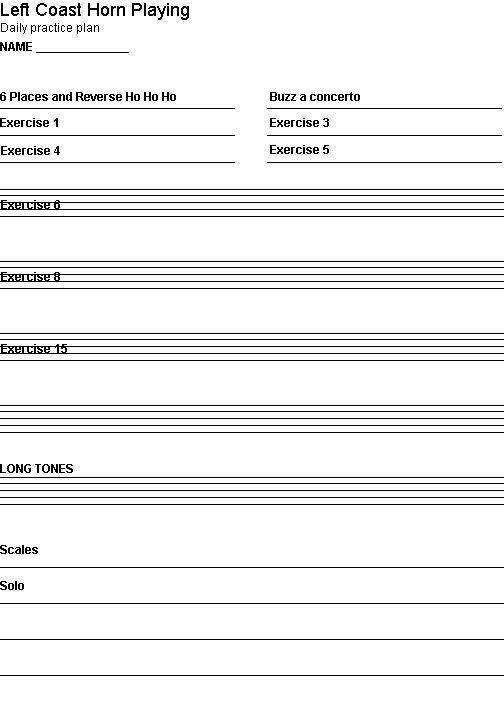
Sample Practice Plans

The basic outline of a Left Coast practice plan
  • Breathing exercises and routines
  • Buzzing exercises
  • A simple exercise done the same way every day
  • Arpeggio exercises
  • Tonguing exercises
  • Exercises for special problems or to develop other techniques
  • Long tones
  • Scales
  • Music
    Each of our exercises can be extended or leveraged. For example Exercise 1b might be played as plain as possible or with decrescendos on the last note, or continued on as low as possible, etc.

    For a young student or beginner the entire routine before the music might only take ten minutes, for an advanced player it can be an hour or more.

    Note that on the sheet we have an area where there are staves. You can write notes or variations on the exercises or write new exercises.


     Click for Printable Version
    Sample Beginner Practice Plan


     Click for Printable Version
    Sample Intermediate Practice Plan


     Click for Printable Version
    Sample Professional Practice Plan


    Hot Tea!

    One trick to learn how to get the air pressed behind the tongue, rather than held by the voicebox is to use the words Hot Tea.

    The idea is to inhale while saying Hot, including getting the tongue in the right position while inhaling. As soon as the tongue is in place (the t in hot) we press the air against it and keep the air pressure inside of you elevated.

    Then release the tongue with an explosion of air while saying (or yelling!) Tea. We want a really hard T, like a hammer striking metal.

    For all of you thinking this isn't tasteful, you are so right. It's an exercise! If done right it's an exaggeration, although there certainly are occasions to tongue like this.

    Our goal is to learn the pattern, the sequence, the feeling. When we tongue quietly we want to use the same sequence and pattern, just not as loud.

    Stopping the Notes with the Tongue and Reverse Tonguing

    For the purposes of these exercises we do not allow stopping any notes with the tongue.

    Many very good players stop notes with the tongue but they have had to spend many hours fighting the problems it causes. Some of them will claim that they can play shorter and cleaner than those of us who do not stop the notes with the tongue but that's bogus.

    One of the most beautiful sounds is a horn playing a beautiful decresendo down to nothing. You can't do this unless you learn to control the air a the end of the notes, and if for this reason only you must learn to play without this evil problem.

    Do not stop any of the notes in these exercises with the tongue.

    Stopping the notes with the tongue almost always means the player cannot stop the air without the tongue and this causes many problems. Many players thrust their tongue forward creating tension in the tongue and throat and restricting the flow of air.

    Players who habitually stop the notes with the tongue frequently have problems starting notes with a clean T. They wind up starting with what we perjoratively call H tonguing. There is no T and all the notes are snuck into.

    Tonguing the end of a note but not the beginning is reverse tonguing and it is evil.

    If you are unable to stop a note without the tongue you have some work to do. You have to accept that for a while you will have trouble ending notes cleanly. That's ok, let it sound bad at first.

    You have to be your own police and every time you catch yourself ending the notes with the tongue you have to be angry! Make it stop! Learn to control the ends of the notes by forcing yourself to use the air rather than your tongue.


    About Left Coast Horn Playing Technique

    Left Coast Horn Playing is a way of practicing and playing that emphasizes training the body and mind to inhale and exhale correctly.  Left Coast Horn Playing takes a logical and behavioral approach and develops controlled, repeatable technique. Our techniques are not designed to produce a single unchangeable style, rather they are designed to give you control over your style by developing a wide palette of repeatable techniques.

    Main features of Left Coast playing and practice

    • We have a daily plan and we follow the plan
    • We focus on controlling the air inside the horn and working daily to improve breathing with the goal of controlling the flow of air from as far down in the abdomen and as far forward in the mouth as possible
    • Knowing what and where the target is and aiming the air at it
    • Getting away from the illusion that concentration and development of the embouchure is more important than focus on air control and emphasizing exercises that develop air strength and control
    • Use of exaggeration in teaching. Sffz, long decrescendos and practicing in a wide range of tempi are typical
    • Clean tonguing and using the tongue to focus the air
    • Working to reduce or eliminate unnecessary movement of the face and tongue by focusing on air control
    • Short progressive and leveraged drills designed to hone in on one particular aspect of playing or combining techniques to make learning efficient
    • Working to improve ensemble skills as well as individual technique

    Monday

    Notes for Conductors and Teachers

    Few instruments seem as romantic and mysterious as a French horn. There are so many great sounds and great musical moments for horn but it is fraught with difficulty and danger.

    We have the smallest mouthpiece, tubing almost as long as a tuba and a bell almost as large. We can blend with the flutes or blast over an entire orchestra. Good players have a five octave range, most of it usable.

    Horn playing is like ice dancing on stilts while doing puzzles and lifting weights, while all the time someone is waving a stick at you trying to get you to dance in time with the music and the other players.

    Check out Whip Your Brass Into Shape for notes on creating a good ensemble.

    General rules that will help your horn players play their best
    • Do NOT have the horns sit in front of the tympani. Even if they don't complain. Many horn players are not even aware that this causes problems. The energy from the tympani goes right into the bell where it concentrates and focuses - right at the embouchure! If your horn section gets tired quickly and misses lots of notes try placing them or the tympani in an other location.
    • Do not ask your horn players to play the same high passages over and over. Even if they play them well you will be tiring them out.
    • Do not ask your horn players to play during your 'warm up' rehearsal right before a concert. How many youth symphonies get ready for playing a Tchaikovsky symphony by playing through the whole thing right before the concert! You are asking high school players to play a difficult, tiring piece of music twice! Your players will feel guilty not playing during your warm up rehearsal and will want to play every note. Don't let them! Do you want me to sound good before or during the concert?
    • Demand that your horn players count
    • Demand daily practice
    • Don't allow slouching or sloppy breathing
    • Don't teach from rote. Make them learn how to read! 

    We believe every player must know how to conduct in order to play intelligently in an ensemble. Make sure they know the basic beat patterns and how prep beats work.

    Teach them to hear perfect intervals and you will have a much better in tune ensembles. Perfect intervals have special qualities on a horn and the players will learn what they sound like if they are pointed out a few times. Read our article on intonation for help on tuning them.

    Bands and orchestra go to great trouble to have all the principal woodwind and string players sit together but brass sections are frequently arranged in a straight line. Why? Your last French horn is now halfway across town from the tuba! Especially in younger groups it will help them greatly to sit as a section. Not only will they play more cleanly they will have more luck entering after a rest together.

    About clams

    No one wants the right notes to come out more than the player. No one. And as difficult as it is we are frequently put in a position that encourages clammy playing.

    The factors you can't change come from the design and writing for horn. We miss more notes than any other instrument mostly because our open notes are so close together. For example on a Bb trumpet there is only one open note between third space C and the G at the top of the staff. On an F horn there are four. For some notes we can use as many as six different fingerings.

    Other factors that make horn players clam are muscle fatigue (embouchure or ab muscles), intonation problems, sudden changes in the room air pressure or temperature and the intonation of the ensemble.

    If a horn player walks into a room where people are warming up and are generally playing in tune it will be easy to play. You want to play an A 440? Someone in the room is probably already playing it or something in tune with it. But if you walk into a room where the intonation is all over the place you will be trying to play an A 440 when an A 443 and an A 438 are going into your bell, fighting your attempt to play.  Instead of the sounds going into your bell reinforcing the note you want to play, there will be sounds interfering with it.

    Asking players to play too quietly or too loud will also cause clams. You have to be judicious. We have to fill the tube with enough air to keep a steady sound and not so much that we break it.

    And try to have a friendly attitude towards your players. If they are truly trying you will not make it better by taking it personally.

    Templating

    We spend so much time and effort trying to learn what the inside of our mouth should be and how to shape the air it is a pity to waste it. But that's what many of us do.


    How likely are we to hit the half note cleanly? Much of it depends on what we do during the eighth notes and the quarter rest.

    If we play the eighth notes nicely then we want to use them as examples, as templates for what is coming up.

    Many players would move their mouths and let their throats collapse as their System changes and relaxed during the rest.  Not Left Coast Players! We would try to keep our entire system as much the same as possible  so that we keep our set up to use on the next note.

    Consider this snippet. Now we have not only a different note after the rest but it is an octave higher! What to do..

    Most players would spend the quarter rest raising their shoulders (and eyeballs), tensing the throat and perhaps taking a shallow, hamster like breath - all things that make the top note harder!

    Left Coast Players know what to do. We try to keep our System as much the same as possible. We will try to aim for both Gs in the same place with as little change in our embouchure or the inside of our mouth as possible.

    We will stay still during the rest and use the G eighth note as a template for the upper note. Even if we take a breath we will try to keep our mouth as still as possible.

    Instead of re-creating our system for the new note we keep the one we had just been using.


    If you ask most horn players what the most important note of this phrase is you will get different answers but to us there is only one - it's the first note.

    It's the note we are most likely to clam. It's also the most useful note!

    If you are careful and play a well supported, cleanly tongued note then you have a template, an example of how to have your system shaped for the rest of the phrase. Since we are trying to make all the notes feel as much the same as possible we want to be extra careful to make the first note nice and use it for all the following notes.

    Templating is also very useful for developing low and high ranges. Start your drills in your mid range and move up or down slowly, trying to keep the mouth shape of the mid range as much as possible.

    What is The Target?

    The Target is where we aim the air.

    It is the center of the upper lip, at its lowest point. If you stick your tongue out and close your lips, it is where you tongue touches the upper lip.

    The Target is where your lip actually vibrates.* It's where we want to aim the air. Always. We can aim up or down but the air must pass through the target.

    Most players aim up higher than the target, especially when playing high notes. Unfortunately aiming above the target makes it harder to play high notes!

    It make so much sense, to aim up when we play high and to aim low when we play low.  Fortunately for those of us in the know aiming up or down doesn't make the pitch go up or down.

    What makes the pitch go up or down depends on the size of the aperture (the hole where the air goes out your lips), the speed and intensity of the air and the tension of the lips.

    Note that we are talking about aiming the air at the Target or above or below it.  All air should be aimed at the Target regardless of pitch or range.

    This straight ahead kind of playing has numerous advantages
    • It helps to keep the tone quality good and similar in all ranges
    • It make slurring smoother
    • It allows for large leaps without changes in tone
    • It helps you understand where to tongue

    Why Tongue at the Target?

    Tonguing at or near the target produces clean and powerful attacks and reduces the movement of the tongue. Moving the tongue too much brings the back of the tongue into play, constricting the flow of air, changing the tone and slowing the tonguing down.

    When most people tongue at the Target for the first time they can't believe it can work because they are so used to tonguing higher.

    Having a Target gives you something to aim at

    How handy!

    You know that feeling right before a high, quiet entrance? How are you going to get the first note to sound nice? Wouldn't it be great to get rid of that abstract, almost lost feeling?

    You have a really loud entrance and don't want to splat the first note?

    Give your brain and body something to focus on! Think about the target, where it is and how you are going to deliver the air to it.


    * Yes we know vibrates is the wrong word but let's keep it simple.

    The Illusion of Up

    Where are high notes? On the ceiling? Are low notes on the floor?

    There are two factors that cause us to believe the Illusion of Up. When we begin playing we have no muscles in our embouchure and every note can seem 'heavy.' We feel like we have to hold our embouchure up for every note.

    The worst part of the illusion is the very terms we use. High notes and low notes and middle range notes. High notes are written higher up on the page. Lower notes are written lower. They could be reversed. But if we turned music writing completely upside down it would confuse us because we believe the illusion.

    What makes notes higher on a horn? We need to make the aperture smaller, increase tension in the lips and increase the speed of the air.

    The things that we do to aim up - tensing the cheeks, turning the lower lip forward, raising the shoulders, etc. makes it more difficult to play high! Try to play straight ahead!

    A demonstration we do frequently is to hold a finger up and ask a student to aim right at the finger tip and play a note. We then ask for a lower note and we move the finger tip higher. The player will see that you indeed can aim higher for a low note and lower for a high note.

    Don't Drop Your @#$&!@# Jaw!

    Few words have done more damage to horn players' low ranges than the dreaded 'Drop the Jaw.'

    To develop a controllable focused low range try not to move your jaw when you play lower. Practice playing in the mid range and using that mouth shape as a template for your low range.

    Dropping the jaw before the note starts does several things, all of them bad.
    • It makes it difficult to focus the air
    • It causes the back of the tongue to move up, restricting the flow of air
    • It makes it almost impossible to return to the middle or upper ranges without terrific amounts of tension
    Note that we do not say the jaw does not move or the mouth get slightly bigger when playing low. The difference is that we let our mouth relax and find the right shape from the acoustics of the note. We do not try to put the mouth in the right shape first.

    We want the shape of our mouth for our lowest and highest notes to be the same as much as possible.