Showing posts with label practice plan. Show all posts

Saturday

Notes for Private Teachers

Teaching is such a difficult thing to do well. It involves at least two personalities working on very long term developments.

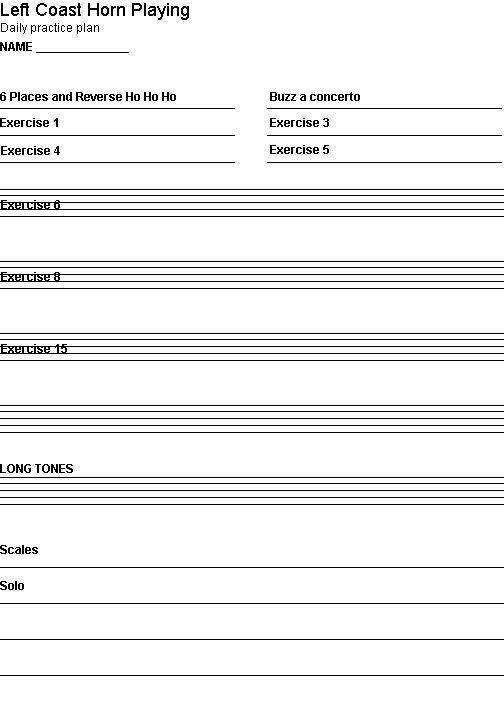
Make sure your students know exactly what to practice and how many times to do it. We at Left Coast Horn Playing require our students to practice their lessons every day. At the end of each lesson the student as a completed Practice Plan. We provide Sample Practice Plans here.

Be positive positive positive! Horn playing is such a mental game every negative experience can have a long term effect. Be supportive and as fun as you can be while guiding your students to improvement.

Focus on what works! Most embouchure problems can be solved by working on breathing. Moving an embouchure around when the breathing causes the throat to be tense is practically worthless!

Teach your students to count. They won't get it on their own and 99.99% of school and youth organizations don't require it. Drum it into them! But what an advantage as a player to have a rhythmic framework for their playing.

Make sure your students know how to conduct. They should at least be able to do a preparation beat and conduct the basic 2, 3, and 4 patterns. How can you play in an ensemble without understanding what the conductor is doing?

Try to get your students to see their shortcomings just as details to work on rather than a personal statement about themselves. If you ask any horn player they will tell there are one or two things they worry about all the time, whether it's tonguing or endurance problems or whatever. Give them a plan on how to work the problem so it becomes just another technical detail rather than a matter of self worth.

If a student doesn't inhale properly stop them! Don't let them set themselves up for problems before they even start playing! You have to be their cheerleader and your cheer must be 'sit up straight and take a deep low breath!' You must be relentless or they will descend into all sorts of problems.

You can teach well even if you are not a fine player but there is no substitute for sitting next to a good player and hearing what it really should sound like. For the student it gets rid of some of the misimpressions, like good players don't miss notes or have a fuzzy sound or need to warm up, etc. And of course it gives the student an example of how to play and reinforces that we actually do what we preach.

We recommend no more than 3 important points for the student to remember from the lesson. At the end of the lesson recap in plain language exactly what you want the student to do. Handing them a proper Practice Plan and saying 'this week I want you to focus on tonguing cleanly, keeping your left hand in the correct position and increasing the speed of your scales' will have the student leaving knowing exactly what to practice.

Play for your students! Nothing teaches them what to do like sitting next to a competent player who shows them how to get it done.




Wednesday

Sample Practice Plans

The basic outline of a Left Coast practice plan
  • Breathing exercises and routines
  • Buzzing exercises
  • A simple exercise done the same way every day
  • Arpeggio exercises
  • Tonguing exercises
  • Exercises for special problems or to develop other techniques
  • Long tones
  • Scales
  • Music
    Each of our exercises can be extended or leveraged. For example Exercise 1b might be played as plain as possible or with decrescendos on the last note, or continued on as low as possible, etc.

    For a young student or beginner the entire routine before the music might only take ten minutes, for an advanced player it can be an hour or more.

    Note that on the sheet we have an area where there are staves. You can write notes or variations on the exercises or write new exercises.


     Click for Printable Version
    Sample Beginner Practice Plan


     Click for Printable Version
    Sample Intermediate Practice Plan


     Click for Printable Version
    Sample Professional Practice Plan


    About Left Coast Horn Playing Technique

    Left Coast Horn Playing is a way of practicing and playing that emphasizes training the body and mind to inhale and exhale correctly.  Left Coast Horn Playing takes a logical and behavioral approach and develops controlled, repeatable technique. Our techniques are not designed to produce a single unchangeable style, rather they are designed to give you control over your style by developing a wide palette of repeatable techniques.

    Main features of Left Coast playing and practice

    • We have a daily plan and we follow the plan
    • We focus on controlling the air inside the horn and working daily to improve breathing with the goal of controlling the flow of air from as far down in the abdomen and as far forward in the mouth as possible
    • Knowing what and where the target is and aiming the air at it
    • Getting away from the illusion that concentration and development of the embouchure is more important than focus on air control and emphasizing exercises that develop air strength and control
    • Use of exaggeration in teaching. Sffz, long decrescendos and practicing in a wide range of tempi are typical
    • Clean tonguing and using the tongue to focus the air
    • Working to reduce or eliminate unnecessary movement of the face and tongue by focusing on air control
    • Short progressive and leveraged drills designed to hone in on one particular aspect of playing or combining techniques to make learning efficient
    • Working to improve ensemble skills as well as individual technique

    Saturday

    Sample Practice Plans

    The basic outline of a Left Coast practice plan looks like this
    • Breathing exercises and routines
    • Buzzing exercises
    • A simple exercise done the same way every day
    • Arpeggio exercises
    • Tonguing exercises
    • Exercises for special problems or to develop other techniques
    • Long tones
    • Scales
    • Reading and learning music

    Each of our exercises can be extended or leveraged. For example Exercise 1b might be played as plain as possible or with decrescendos on the last note, or continued on as low as possible, etc.

    For a young student or beginner the entire routine before the music might only take ten minutes, for an advanced player it can be an hour or more.

    Sample Beginner Practice Plan
    Ten minutes
    • Reverse Ho Ho Ho and 6 Places
    • Mouthpiece buzzing exercise
    • Exercise #1b (done allegro with brick shaped notes)
    • Exercise #8
    • Long tones
    • Scales
    • Etudes, solos and music preparation

    Sample Intermediate Practice Plan
    Half hour
    • Reverse Ho Ho Ho and 6 Places
    • Mouthpiece buzzing exercise
    • Exercise #1b (done allegro with brick shaped notes)
    • Exercise #2
    • Exercise #3
    • Exercise #4
    • Exercise #6
    • Exercise #8
    • Long tones
    • Scales
    • Etudes, solos and music preparation
    • Exercise #1a
    Notice that Exercise #1a is always done last and every other day.

    Sample Practice Plan for a Professional Player or Advanced Student
    45 minutes to an hour
    • Reverse Ho Ho Ho and 6 Places
    • Mouthpiece buzzing exercise
    • Exercise #1b (done andante and going down as low as possible)
    • Exercise #2 (with extended variations)
    • Exercise #4
    • Exercise #5 (all versions)
    • Exercise #6 (two octaves)
    • Exercise #7
    • Exercise #8 (for double tonguing, high and low range practice)
    • Long tones
    • Scales
    • Etudes, solos and music preparation
    • Exercise #1a

    Strength and Efficiency

    Strength is good. Efficiency is good Strength plus efficiency = the best!

    Knowing which muscles need to be strong and which need to learn to relax is key. We need to have the muscles at the corners of our lips to be very, very strong. We need our lower abs to very strong. That's about it.

    We need to keep the muscles of the throat relaxed, especially the lower part of the tongue. Your tongue is probably longer than you think. When you swallow the lower part of your tongue helps to push the material down your throat. You can feel the tongue flexing all the way down to your vocal chords.  

    Tension in the back and bottom part of the tongue is one of the most common problems in brass playing.

    How do we overcome this tension? By breathing from Place #6. Controlling the air in our out from above Place #6 causes causes tension in the throat.

    To gain the strength in Place #6 we constantly remind ourselves to breathe from there. We strengthen those muscles simply by breathing correctly over and over.

    We strengthen our chops by playing progressively longer and higher drills. Long tones are very important. Long descrescendos help too.

    We define efficiency as the percentage of air that goes through the mouthpiece without increasing the buzzy quality of the buzz. You can hear two things in a buzz, the raspy buzzy sound and the hissing of the air. The hissing airy sound is the inefficient air.

    The airier and hissier the sound of the buzz the less efficient. The raspier and buzzier the sound the more efficient.

    Some benefits of being more efficient are obvious but there are many that are not so obvious. Intonation is greatly improved with an efficient buzz, as are endurance, flexibility, steadiness, tonguing, quiet playing and phrasing.


    Wednesday

    How to Play Left Coast Exercises

    Left Coast exercises are meant to be concentrated and leveraged. They are short so we can really focus on what we are trying to accomplish. They are designed to be flexible and extensible.

    Always play them with a steady rhythm and start slowly!

    In all the exercises have these goals in mind

    If you don’t take a deep low breath, controlling the air from Place #6 then none of this matters. While playing these exercises always take a deep, relaxed breath, controlling the air from as low in your body as possible.

    When the exercises advise you to keep the same tone color throughout, we are looking for brightness. Some of our exercises ask you to decrescendo without changing tone color. You can only do this if you control the air from below Place #5, halfway between your rib cage and your belly button.

    We use these decrescendo exercises not only to learn to make beautiful decrescendos and control the ends of the notes but to train ourselves to control the air from as low as possible.

    Some of our exercises have sffz on them. These are to be played loudly and with as much air as is possible to push through the horn. Play them loud all the way through with no decrescendo or softening at all. Be tasteless and wild! If your neighbors call the police you are doing it right!

    If the exercise says to play Slow to Fast, then start really really slow. The slower the better. You can increase the tempo right away but start out really slowly.

    For Slow to Fast exercises go faster and faster until you reach the point it falls apart. Never play as fast as you can then quit. Go faster! Always push!

    In all technical exercises every day try to go higher, lower, faster, slower, louder, quieter! Always push yourself!

    While these exercises can be done occasionally you will improve very fast if you do them every day. Ten minutes a day doing these drills will help you improve much faster than doing them for once for an hour each week.